You should make mindmaps
All my notes are mindmaps and it's the best thing I ever did to speed up my learning.
February 1, 2026
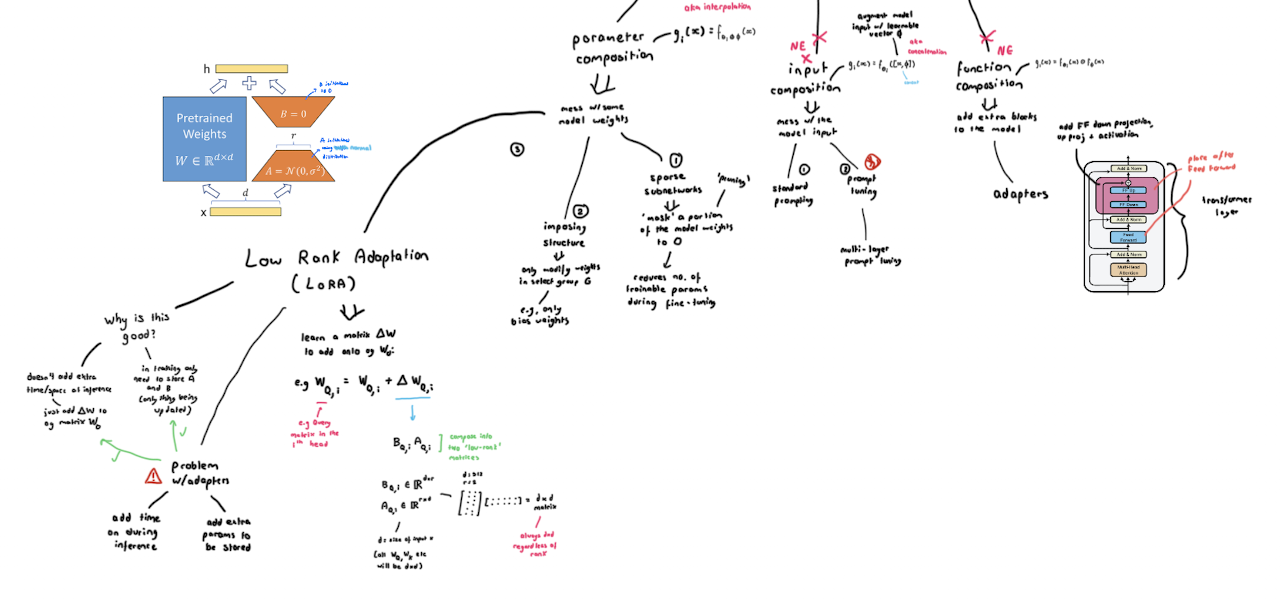
In my last two years of university, I learnt how to achieve the best grades I ever had, while studying the least I ever had. Below I share 4 things that really helped me do this.
1. Make mindmaps!
Mind maps are the most underrated form of studying. I wasn’t a mind mapper until I started watching Justin Sung’s videos, and learnt how to make good ones, and now I’ve been fully converted. I will admit they are 10x easier to make if you have a tablet, where you can use some infinite canvas software (I use Prodrafts).
Above I have an example of my mindmap for one of my NLP courses. This mindmap is literally my entire notes for the whole course in one big infinite canvas. As you can see, there aren’t big blocks of text. There are lots of diagrams, arrows, and some maths derivations and equations.
I won’t go into the science of mind maps too much because Justin Sung covers it much better but in a nutshell: 90% of learning is all about making connections to stuff. When you’re learning a topic, you need to be able to distill it and understand how it connects to other topics, so that when you are asked a question about it, the correct relevant information can fire.
This is why flashcards are bad - if the exam question is not the same as your flashcard, it’s unlikely the correct knowledge in your brain will fire. Having a mind map for your entire course aims to fix just this, because you see concepts connect to each other by physically drawing lines between them. You will notice parallels between things and be able to retrieve them together, even if they were in different lectures.
When you start mind mapping the right way, you'll be shocked by how much better your mental models get, how much faster things click into place. You'll also be shocked by how much you'll still be able to recall for years after your exam, instead of forgetting it all immediately!
2. Act like it matters
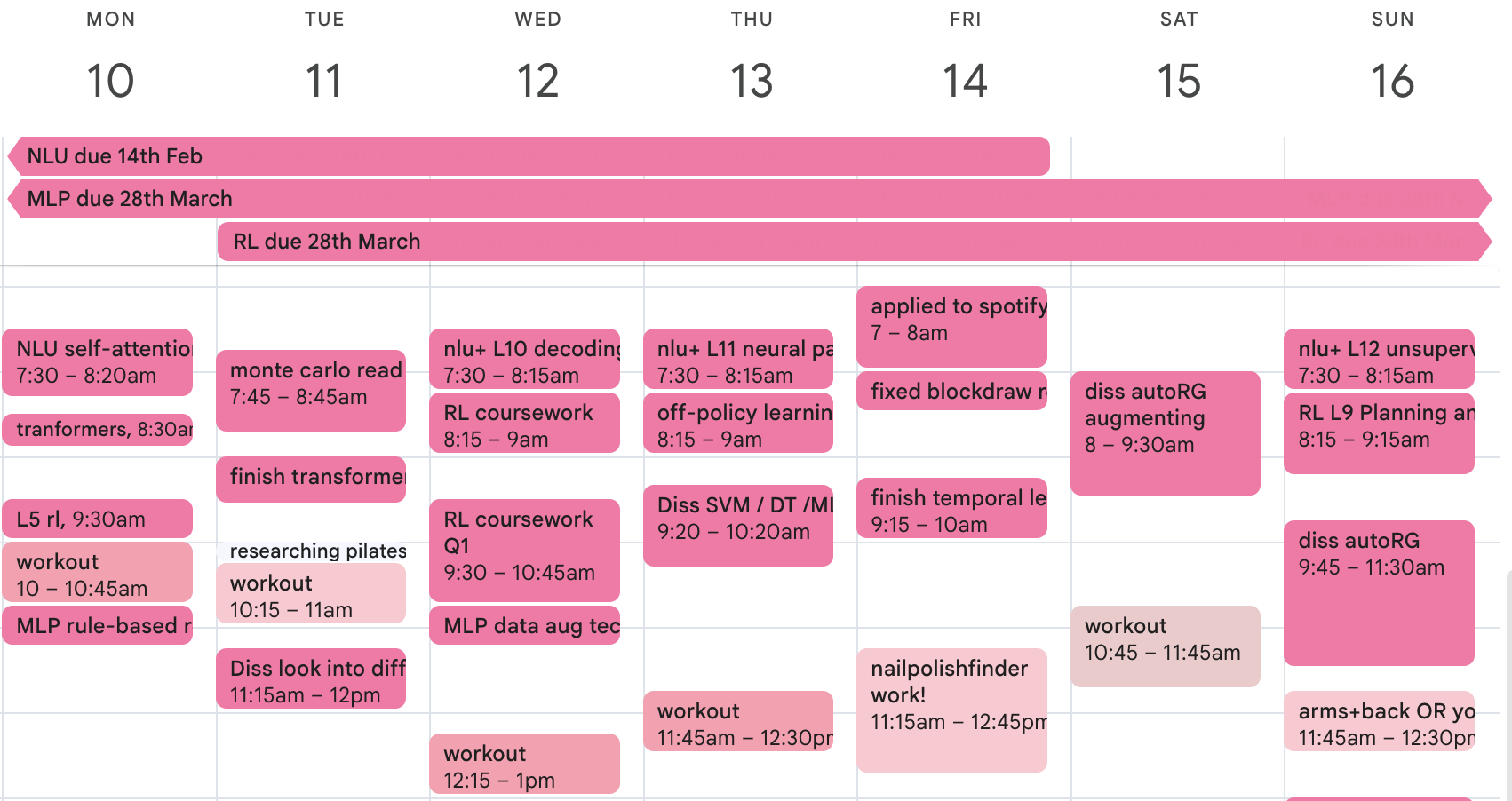
If you want to do well in your degree, you have to start acting like it actually matters to you. This means setting aside dedicated time, probably every day, to work at it. It’s okay (and important!) to still have other things in your life - in 4th year I had a part-time job, was involved in societies and was working on side projects and internship applications - but I still dedicated a portion of my time to be concentrated on my degree. It’s not about how much time you spend, but about the mental priority it holds. On average, I spent 2-3hrs a day studying, but those hours were the first and non-negotiable thing that had to get done in the morning. Point is, don’t leave your degree for last, or you won’t be able to give it the focus it needs. Be clear with yourself about your priorities!
3. Really encourage others to ask you questions
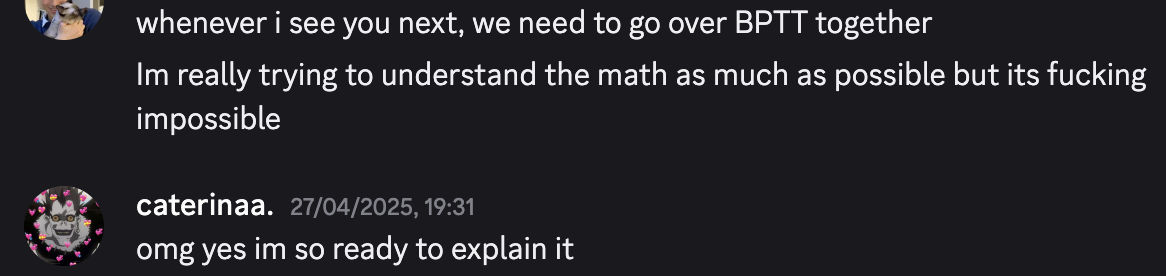
Teaching others is a great way of testing the depth of your understanding, and I wish I’d started treating this as a proper study technique sooner. When I was studying for my NLP exam, I actively told my friends to send any questions they had about the content my way, and that I’d be happy to answer them. For example, I met up with my friend to take him through Backpropagation Through Time in RNNs until he understood why the gradient updates equations cause the vanishing gradient problem. Answering other people’s questions will reinforce your learning and reveal your areas of weakness really fast. So, do it as much as you can!
4. Being efficient will give you your time back
No one wants to be stuck at home all day studying, so the key is to find ways of easily incorporating it into your day. This will be different for everyone, but below is my workflow for getting everything done with a consistent 2-3 hrs a day:
- Turning my slides into podcasts. Instead of listening to my lectures, I would use the slides to make a ~15 min podcast with NotebookLM and listen to that while on a walk, which gave me a high-level idea of what the lecture’s about. Then, I would come home and read through the slides, annotating them and prompting ChatGPT till I understood everything. Lastly, I would distill this into mindmap form on my existing mindmap for the course.
- Making a question bank for later. Sometimes you will have questions about the content that you don’t have time to address (maybe low priority) and have to come back to later. I put anything I didn't fully understand into my notes app, so that when I was busy doing something else (on a walk, cooking), I’d use ChatGPT’s voice model to answer my questions until I felt I understood. This saved me time by multitasking!
Bonus - celebrate your wins!
It’s too common for high-achieving students to feel next to nothing when they achieve their goals, and just feel relief they didn’t fail to achieve. I used to be like this until I actively got myself to start celebrating wins. If one of your friends aces their dissertation or gets the job they wanted, buy them a coffee or go out for dinner and take a moment to hype them up, even if they don’t feel it’s a big deal. Sometimes these good things pass us by so quick we don’t even acknowledge them, but I find the positive reinforcement makes us more motivated to keep achieving. So, celebrate your wins!